
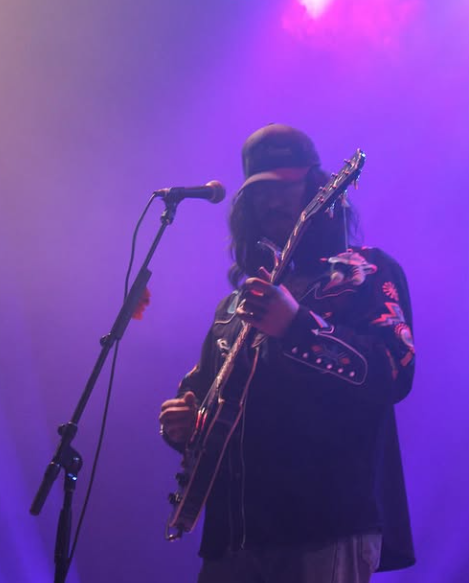
How did your journey in music begin, and when did you realize it was something you wanted to pursue seriously?
I grew up in a musical household. My mother and grandmother were classically trained pianists, my father ended up going through his whole life seeing the evolution of the underground in the 60s, 70s, and 80s. I was exposed to music from the very beginning. According to my mom, Bob Seger was on the radio when I was born. She also was a fan of Neil Young, and had his album “Harvest” on rotation during trips to my grandparents place out in Goshen County, Wyoming. My dad grew up with bands like Led Zeppelin, Black Sabbath, Gordon Lightfoot, and a myriad of others. His top band was The Rolling Stones. There were mornings where my dad would take me to school, and he had a tape cassette of “Tattoo You”. I loved that album. But we had a game where we would annoy each other with certain songs from our favorite albums. His was setting the tape to the song “Neighbors”, which is a banger. But, when repeated every single morning, it can really take a toll on your sanity.
I started playing music at a very young age, and when I started second grade, I picked up cello. I still play it today, but I don’t associate myself with classical as much as I used to when I was younger.
In terms of continuing music, I wanted to be a session musician. I didn’t want to limit myself to just cello, so I picked up a few extra instruments along the way: guitar, bass, and drums. Later on, it really served me well, as I was able to pick up a gig with a friend of mine in Fort Collins, Colorado as his cellist, then playing guitar and bass with a local band in Laramie, Wyoming.
I loved the fact I could still play my primary instrument (cello) in environments other than a concert hall. So I decided to forge a path that way.
Can you describe your creative process—does it come from instinct, planning, or a mix of both?
I have been told that my approach to writing my songs is…unique. As ridiculous as it sounds, I think it’s right to me.
I start out with writing lyrics. It can range from drawing from my personal experiences growing up in Wyoming, other people’s experiences, or taking both elements and fictionalizing them into a story. I have a lot of lyrics that I have stowed away that I don’t have music for yet. But in time, the music will come.
When I get an idea musically, I start out with a basic chord structure. It can be anything that sounds gorgeous with the tunings I use, or something atonal that can thrown into a section that won’t have any words. Then I start finding bits and pieces and start shoving them together. It’s like a jigsaw puzzle that has pieces forced in together. To other folks it won’t make sense to them, but it makes sense to the person who did it. Once I find a good structure between the tidbits, I look for lyrics that will fit the song, and I start jotting down a form on notation paper, then label the sections as verses, choruses, bridges, special sections, etc. This will usually become what will be known to me as “The Take”. Everytime I write a song, I want to make sure that it sounds like it is ready to be recorded. I got the idea from Brian Wilson when he was discussing “Pet Sounds”, which is an album where every note was played for a reason. He wrote all the parts for each song with care, and Wilson being an idol of mine, I wanted to make sure that I approached each song I wrote with care.
How has your approach to songwriting and production evolved since your earliest releases?
It was better than when I was in college. I messed around with guitar tunings early in high school on an acoustic guitar given to me by my godmother. Most of my earlier songs I considered to be really corny, but later on, they were a base for trying to be honest with what I was feeling and how I saw other people and the world. My songs nowadays feel therapeutic. I’m exorcising some intrusive thoughts that kept haunting me during long nights.
When I released my first EP, “Immanuel Missionary Tabernacle”, it was a moment in time where I wanted to experiment with something new. Everything was recorded on an electric guitar through a Zoom recorder. That thing glitched out on me during some takes and I had to redo certain areas that made it tedious. I still feel like it was a great starting point, but I wanted to make something that was more true to the sound I wanted.
With every song, I have an idea about how the instrumentation should go, how the guitar part works, and what direction it should go. With each pass through of the song while recording, I find something where I go, “I think we need to have just one small portion of this instrument here”, and that would be the only spot where it would come in. I have this weird habit of including some shocker moments in my newer songs, that it even surprises me that I would include it in there. But so far, it works, and that’s all that matters.
What is the most valuable lesson you’ve learned from your artistic journey so far?
Keep being yourself. Even if you have an alter ego for the stage, don’t let that dominate who you really are.
The other thing is, treat music as if it were a person. Music has feelings and the worst thing that can happen is hearing something that has no heart, personality, or brains. It needs to show some glimpse of hope.
The title “Early Virgins” is both striking and mysterious. What inspired it?
This is a hilarious story. I used to work as a bus driver for the University of Wyoming, and there was one guy who I worked with whose name was Don. Sometimes when I was smoking outside, he would be coming back from his route and we’d just have a hangout and talk about anything that came to our minds. But I told him about making something new for my project and I said, “Every artist compilation that releases material that has never seen the light of day has something added to the title of the compilation like, ‘Early Days’, ‘Early Years’, and so on…why not make an EP that has the title ‘Early Virgins’?” And my coworker thought I should run with it. So I did.
My material might be depressing, but you gotta stay silly sometimes.
How did the concept for this EP develop—was it envisioned as a cohesive project from the start, or did it come together more organically?
The songs ranged from material I wrote a few years back that didn’t have a place on any future albums. It was more of an inorganic process.
So I wanted to do four songs, and I had no clue which songs I wanted to put onto this thing. So I started hunting down the songs that might at least have some emotional diversity between the lyrics. I chose my four, and I have two positive ones in the beginning, and then I chose two downers that I thought would work. So it ended up working in my favor, I thought.
Is there a track on “Early Virgins” that holds particular personal significance for you?
The final track, “Gone”. At this point, I might have to say it’s up to you for interpretation. Because in reality, it’s a dark song.
The EP’s production feels carefully curated. How did you approach defining its sonic identity?
I love combining different instruments to create an unusual texture. My addition of my friends, Travis Beam, Chris Lamb, and Coleman Walker, made it to where I wanted them to be themselves as much as they could. Turns out that having friends who are in tune with music as much as you are really made a difference. I currently have an album in the works that is made up of friends who I met who live in Denver. The reason why I chose them was because of their musical intuition. But that will be something for later…
For the EP, I made it a point that I wanted to start blending my love for organized chaos with the material that I wanted to perform. Then I started looking inward to who I loved listening to the most growing up…Neil Young, Gram Parsons, The Flying Burrito Brothers, Roy Harper…
If you think about it, there are a lot of great songs that incorporated pedal steel in the most unusual ways. Even Steely Dan did this.
What challenges did you face while bringing “Early Virgins” to life, and how did you overcome them?
I became a new father on September 16, 2024 to a wonderful baby girl. She is now one years old and we have an addition of a baby boy on top of that who was born two days before her birthday. I guess we can consider him an early birthday gift.
So the year I became a father, I went into my dad’s makeshift studio where I kept the majority of my gear. So I recorded the guitar and vocal tracks within a day, and asked a few people to guest on it. Some of them proved to be very flakey and one of them was an egotistical kid who thought he was better than everyone else. But I gotta admit, he had one hell of a voice. So I ended up with three great fellas: Travis Beam (pedal steel), Chris Lamb (banjo), and Coleman Walker (harmony on “King of Hearts”). I really clicked with these guys, and all of them have such an appreciation for music that we really clicked into the work.
Was there a defining moment in the studio when you knew the EP had found its true direction?
“King of Hearts”. Travis really made his pedal steel feel like a string section, and with the addition of Chris’ banjo, it completely sucked you in. There was one moment when Travis goes into his pedal steel solo where he drew from somewhere inside himself and made the thing cry. This is the kind of heart I want in my songs, and that moment was the one where it completely changed how I saw these songs.
Did the process of creating this EP teach you anything new about yourself as an artist or individual?
I knew I was a peculiar individual, but messing around with mic placements, and mixing certain instruments in an unusual manner to bring something out gave me something that I could look forward to.
I’m currently on a good foot to start work as an assistant engineer at a place in Laramie called Timber Canyon Studios, run by Jim and Marie Roberts. They are great folks and I am so glad that both of them gave me this opportunity to work on projects that come through their studio and works of my own.
Looking ahead, what can listeners expect next from wAHb—are there new sounds or projects already taking shape?
I have one album I am finishing up called “Four Yellow Crosses”. That one is in the process of getting vocals on a couple of the tunes and one more track to complete before I send it off for mastering.
The second album, “Exile in Goshen”, is in its early larval stages of production, and I’m getting details organized with my guys up here.
I do have a title for a third one:
“Whiteman”
I jokingly call these a trilogy series.

